There is no bad month, only trade-offs. Here is what each one actually gives you, and what it costs.
Almost every operator will tell you that June to October is the best time to visit Tanzania. That is true in the narrow sense that game viewing is easiest then — and it is also the answer that happens to sell the most expensive months of the year.
The more useful answer is that Tanzania has no bad season, only different ones. What follows is what each period actually delivers.
The dry season: June to October
The classic safari window. Vegetation thins out, animals concentrate around permanent water, and the sky is reliably clear. Mornings are cold — genuinely cold on the Ngorongoro rim, where 2,200 metres of altitude means you will want a fleece at dawn.
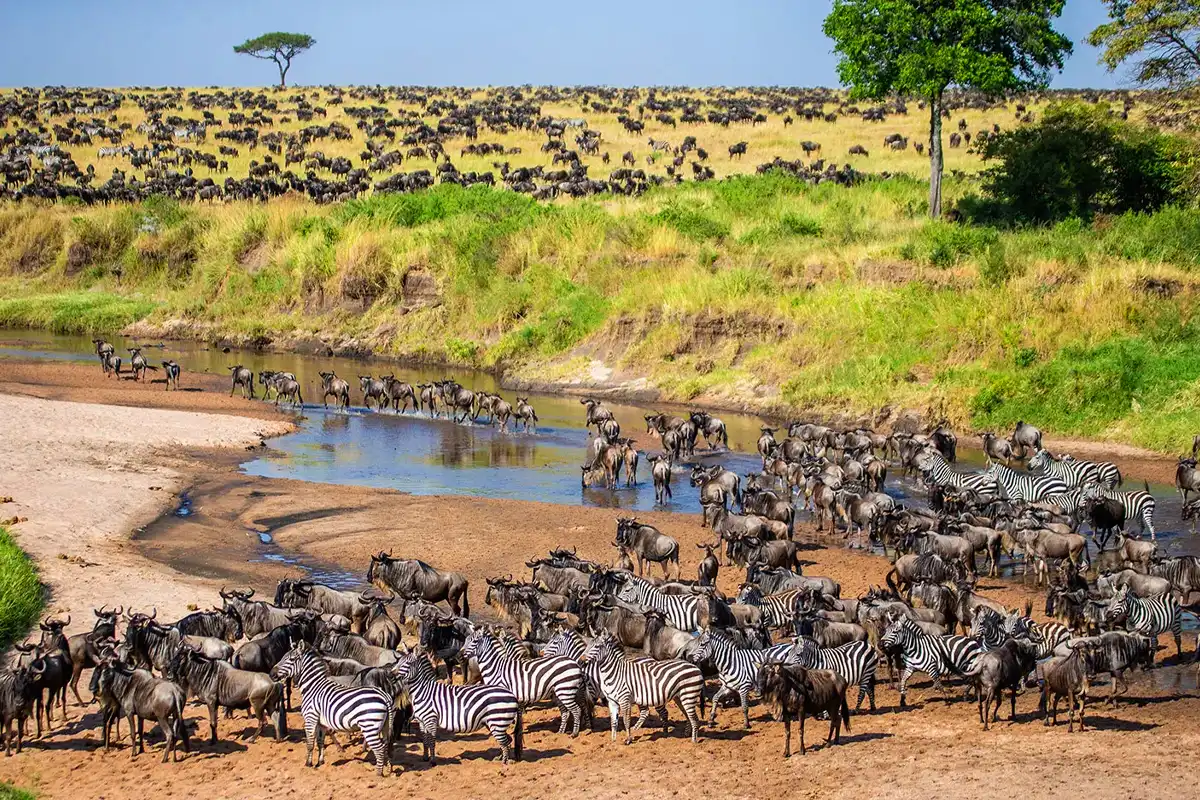
This is also when the Mara River crossings happen in the northern Serengeti, from roughly July, which is why July to September carries the highest prices of the year and why the best northern camps are booked nine to twelve months ahead.
Choose it if: this is your first safari, you want the easiest possible game viewing, or the migration crossings are the reason you are coming.
Be aware: it is the busiest and most expensive time, and popular sightings attract vehicles.
The calving season: late January to March
Our own favourite, and the one most first-time visitors have never considered. Something in the order of half a million wildebeest calves are born on the short-grass plains around Ndutu in a window of about three weeks in February. Every predator in the ecosystem responds.
Because much of this happens inside the Ngorongoro Conservation Area rather than the national park, off-road driving is permitted — which changes what you can actually watch. Prices sit well below the July peak and the crowds are a fraction.
Choose it if: predator behaviour interests you more than a river crossing, or you want the very best of the Serengeti without the very worst of the crowds.
Be aware: there are short afternoon storms, and the calving is not perfectly predictable.
The green season: April, May and November
April and May are the long rains and November brings the short ones. Some camps close. Roads in black-cotton soil become genuinely difficult. Game is more dispersed because water is everywhere and animals do not need to come to the rivers.
What you get instead: a landscape that is spectacularly green, dramatic skies, outstanding birding as migrants arrive, almost no other vehicles, and prices that can be half the dry-season rate.
Choose it if: you have been on safari before, you are travelling on a tighter budget, or you photograph landscape as much as wildlife.
Avoid it if: this is your one safari and you want certainty.
What about Zanzibar?
The coast runs on a slightly different calendar. June to October and December to February are the reliable windows. April is genuinely poor on the island — heavy rain, poor visibility for diving and many hotels closed. If your safari falls in April and you want a beach afterwards, we would generally suggest reordering the trip rather than pushing on to the coast.
The short version
If you want easy game viewing and river crossings, come between July and September and book early. If you want the best predator action and better value, come in February. If you want a green, empty, cheap Tanzania and you have seen a lion before, come in November.
Tell us your month and we will tell you what to expect.